
Wooden beam ceiling: Measurement of impact sound reduction on lightweight construction ceilings according to ISO 10140-3
Receive a quote tailored to your needs
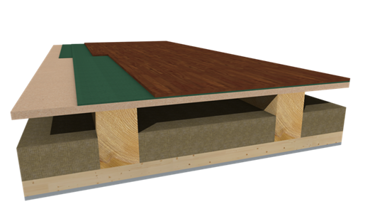
In this test, the impact sound of the wooden beam ceilings can be reduced by means of standard hammering or rubber ball (for low frequencies). This reduction is given as a result for the structure.
Our customers are from the following sectors, among others?
- Manufacturers of ceiling supports
- Floor coverings
- Floating screeds
- Subfloor systems
Your advantages at a glance
- Obtaining measured values on wooden beam ceilings (for renovation and existing buildings)
- Cost-effective testing option, the reference ceiling is permanently available in the laboratory
- Reliability in the planning and evaluation of constructions in timber construction
Building Acoustics Testing - Precision for Optimal Sound Insulation
Airborne sound insulation of building products ISO 101402; measurement of sound absorption in reverberation chambers ISO 354; determination of sound absorption coefficient in impedance tube ISO 10534-1/2; determination of dynamic stiffness ISO 29052-1; testing of noise characteristics of fittings & equipment ISO 3822

Sound Insulation for Construction Products
Our DAkkS-accredited testing laboratory, certified to DIN EN ISO/IEC 17025, offers standard-compliant testing for construction products in accordance with harmonized European product standards. As a Notified Body under the EU Construction Products Regulation (CPR), we support manufacturers with conformity assessment and market authorization in Europe—supplemented by recognized testing in accordance with state building codes, as well as comprehensive testing, inspection, and certification services through the Kiwa Group network.

Airborne Sound Insulation - Standard-Compliant Tests in Accordance with DIN EN ISO 10140, DIN EN ISO 717-1, and DIN EN 1793-2
We determine the airborne sound insulation of building components, facades, and noise control systems in accordance with current DIN standards—including Rw, C, and Ctr ratings.

Sound absorption measurements in accordance with DIN EN ISO 354, DIN EN ISO 11654, and DIN EN 1793-1
In the anechoic chamber, we determine the frequency-dependent sound absorption coefficient of building materials and absorbers. This includes αw rating and absorber classification.

Impact Sound Measurement According to DIN EN 16205 – Including RWS Rating
We evaluate the impact sound performance of floor coverings in accordance with industry standards. This includes Radiated Walking Sound (RWS) for a realistic assessment of auditory perception. Teaser

Acoustic testing of fittings in accordance with ISO 3822 and issuance of general building inspection certificates (abP)
We test the noise performance of fittings in accordance with ISO 3822 and issue recognized abP certificates—for safe use in buildings where sound insulation is important.

Testing the sound power level in accordance with DIN EN ISO 3741 in a reverberation chamber
Using the Class I method in accordance with DIN EN ISO 3741, we determine the sound power level of technical devices under precisely defined reverberation chamber conditions.

Blower-Door Tests – Air Tightness Testing According to DIN EN ISO 9972
We use blower-door tests to assess the airtightness of buildings, identify leaks, and provide reliable evidence of energy efficiency and construction quality.

On-site measurement of sound insulation in accordance with DIN EN ISO 16283 and DIN 10052
We conduct standard-compliant sound insulation measurements directly on-site—for new construction, existing buildings, and renovations—and provide detailed test reports.
Design Services – Sound and Thermal Insulation, Noise Control
As an experienced acoustics and building physics firm, we assist you with planning and verification for sound and thermal insulation. We prepare reliable sound insulation verifications in accordance with DIN 4109, thermal insulation verifications in accordance with GEG, and forecasts for noise immission control in accordance with TA Lärm, the 16th BImSchV, and the Leisure Noise Directive—practical, cost-effective, and compliant with standards.