
Field Exposure
Why field exposure testing matters
Kiwa PVEL’s field exposure testing is designed to reproduce typical installation and operating conditions for a PV module, and characterize its performance in a real-world environment for an extended duration. This is important considering that the other PQP tests subject modules to a limited number of stresses simultaneously (such as temperature and humidity, or temperature and current injection), whereas in field applications modules can be subjected to all stresses simultaneously (including current, maximum system voltage, thermal cycling, UV, high temperature, humidity, poor handling/transportation damage, extreme weather, wind loading, etc.). As first year power warranty values become more aggressive, with some n-type modules having a warranted 1% year-one degradation, validating this value through distinct PQP stress tests is somewhat achievable, but placing the module outdoors for one year provides strong evidence as to whether the advertised year-one degradation amount is achievable.
An unique benefit for Kiwa PVEL’s field exposure testing is that it occurs at the historic PVUSA outdoor test facility in Davis, CA. This allows seamless ASTM E2848-13:2018 capacity testing analysis to be performed to calculate PV system DC power values at PTC and corresponding PTC ratios. ASTM E2848 DC Power at PVUSA Test Conditions (PTC) is a common way of evaluating PV system performance to “normalize” for continuously varying weather conditions (leading to continuously varying PV system output). Continuously-monitored PV system power output and concurrent weather measurement data collected during field exposure testing are analyzed over each month, and a single DC power value is derived at PTC (1,000 W/m2 plane of array irradiance, 20 °C ambient temperature, and 1 m/s wind speed), which are more field-representative than STC (especially for the PVUSA test site). Dividing the monthly PTC power values by the corresponding module’s STC rating yields what is referred to as the “PTC ratio”. Investigating time series of monthly PTC power values or corresponding PTC ratios reveals insights on PV system power degradation trends. PTC ratios also provide a way to benchmark the performance of different module types of given module types and/or BOMs relative to one another.
Materials assessed
|
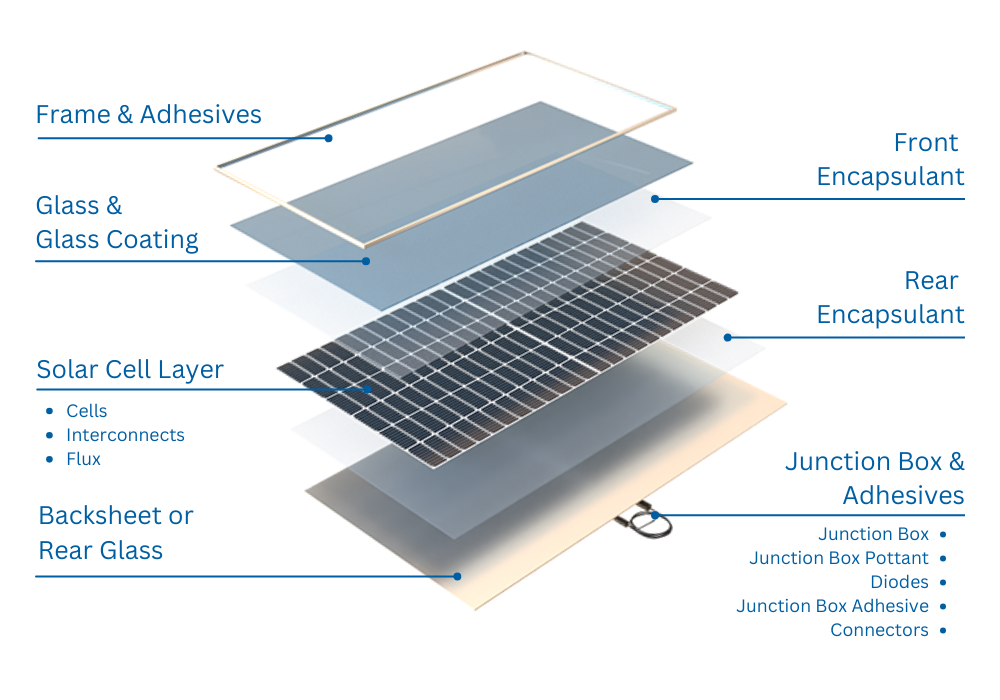
The one-year field exposure test probes the initial performance and reliability of all of the PV module’s materials and their various interactions. |
 |
Test procedure
|
The field exposure (FE) test provides an indication of module degradation over the first year of outdoor deployment, complementing the targeted accelerated chamber stress tests. This test is conducted at Kiwa PVEL’s outdoor testing facility in Mare Island, CA. Two modules are installed outdoors directly after the initial characterizations of IV, EL, WL and VI. No separate light soaking will occur before installation. The modules will be installed on fixed-tilt ground-mount racks and will be connected to a load or micro-inverters to keep the output near Mpp during the deployment. During field exposure, the following sensors are continuously monitored:
Modules are cleaned once per month, unless wet conditions keep the modules clean. After six months of outdoor field exposure, Kiwa PVEL will characterize the modules by conducting IV, EL, WL and VI. These and the initial characterization results will be included in the Interim FE Report, along with summaries of the environmental conditions during the outdoor exposure. The modules are then installed outdoors for another six-month period, followed by a repeat of the above characterizations, and the issuance of the Final FE Report. Some modules experience dark storage degradation that could impact the post-FE results. Therefore, Kiwa PVEL will automatically perform a ≥1 kWh/m2 full spectrum light soak for any BOM that has an average power degradation of ≥2% following the final FE characterizations. Modules will be kept at open-circuit during this light soaking and IV tested within four hours following light soaking. The post stabilization characterizations also include EL. Neither the Interim or Final FE Report will include energy production yield or power capacity calculations. Note that FE testing is optional within the larger scope of a PQP, but it is strongly recommended. |
 |
PV Module Reliability Scorecard
Now available, the 10th Edition of Kiwa PVEL’s PV Module Reliability Scorecard features Top Performers from the industry’s best manufacturers and is the essential resource for PV module reliability and performance insights.