
Mechanical Stress Sequence
Why mechanical stress sequence testing matters
Researchers at the Fotovoltaica-UFSC recently designed a 100 kWp site to evaluate bifacial silicon PV module performance under Brazilian climatic conditions. Located in Florianópolis-SC, Brazil, the project uses large-format bifacial glass//glass modules with 2 mm heat-strengthened glass, installed across five single-axis tracking rows and one fixed-tilt system. Little did they know that they would actually be studying module glass breakage.
Not long after site commissioning, the researchers noticed glass cracks on the front or rear of some modules. Regular inspections were conducted and a trend of 14 broken modules per month was recorded over a seven-month period. Within nine months of site commissioning, over 50% of the installed modules had cracked glass. The weather monitoring data over this period did not show any temperature or wind event anomalies.
As of early 2023, the glass cracks have not impacted system safety or performance. The researchers have thus far found no correlation between glass cracks and cell cracks on EL images, power degradation, or hot spots. But the long-term reliability of modules with broken glass is certainly at risk. The root cause analysis is still ongoing with the module and racking/tracker manufacturers involved.
This is not a unique case of module breakage in the solar industry. The Kiwa Group members have been contacted multiple times in the past two years with reports of broken glass on PV sites. Tracker/racking compatibility with large-format modules is critical, and Kiwa PVEL’s MSS testing on specific module and tracker/racking combinations provides site stakeholder confidence in avoiding these types of issues.
Fotovoltaica-UFSC case study contributed by: Marília Braga, Gustavo X. A. Pinto, Anelise M. Pires, Alessandro H. Zamboni, Lucas R. Nascimento and Ricardo Rüther at Universidade Federal de Santa Catarina, Florianópolis-SC, Brazil (www.fotovoltaica.ufsc.br)
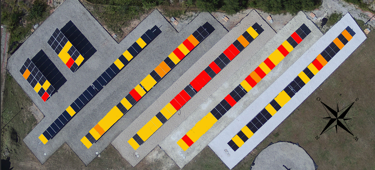
In the majority of cases (59% of all cracked modules) the rear side glass broke. 28% of cracked modules had broken front side glass, and 13% of cracked modules had both front and rear glass broken.
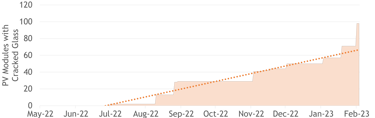
Number of PV modules with cracked glass. The trend line represents ~14 cracked modules per month.
Materials assessed
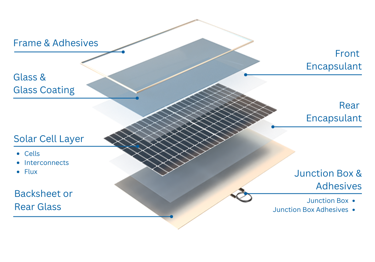
These materials influence the mechanical strength of the cell interface as well as the durability and rigidity of the PV module itself:
Test procedure
|
PV modules mounted in the field may be exposed to mechanical stress due to wind and snow loads; cyclic deflection can result in cracks forming and propagating in the silicon cells and solder joints. Furthermore, the expansion of moisture during the freezing process can be very detrimental to the module integrity. Ice crystals can cause failure of adhered interfaces resulting in delamination or other mechanical failures. The humidity-freeze portion of this test sequence mimics environmental conditions where ambient moisture and freezing temperatures coexist. The test sequence starts with a static mechanical load (SML) test following the guidance of IEC 61215-2:2021 MQT 16. If the module frame has 400 mm mounting holes, the two samples will be mounted using Nextracker’s torque tube and mounting rails, attached to the module using M6 hardware at the module’s 400 mm mounting holes. If there are no 400 mm mounting holes, the 790 mm mounting holes and associated Nextracker mounting rails will be used instead. If the module frame does not have 400 or 790 mm mounting holes, and the module is ≤ 2000 mm in length, it will be mounted via corner-mounted racking (rail-less mounting) using SnapNrack’s RL Universal Mount with SpeedSeal Track, with the Mount Clamps attached on the short-side frame at 200 mm of the corner. If the module frame does not have 400 or 790 mm and is > 2000 mm, Kiwa PVEL will contact the Customer to determine mounting. Once mounted, a reduced test load of 1800 Pa is applied for one hour in the positive pressure direction, then one hour in the negative pressure direction. This then repeats twice, for a total of three positive and negative pressure cycles. The module’s electrical continuity is monitored during SML testing. After SML, a dynamic mechanical load (DML) test is conducted following the guidance of IEC 61215-2:2021 MQT 20, with 1000 cycles of positive and negative loading. Suction cups apply 1000 Pa of pressure loading in both “push” (negative pressure) and “pull” (positive pressure) directions. Module mounting for DML will match what was used for SML mounting. DML is followed by 50 thermal cycles (TC), with current injection as described in Section 5.1. The MSS finishes with 10 humidity freeze (HF) cycles following the guidance of IEC 61215-2:2016 MQT 12. The module is exposed to temperatures of 85°C and a relative humidity of 85% for a minimum of 20 hours before the temperature is rapidly dropped to -40°C for a minimum of 30 minutes (maximum 4 hours), freezing any moisture within the module. Characterizations for MSS occur at pre-stress, after DML and after HF10. The interim (post-DML) characterizations include IV, EL, WL and VI. The pre-stress and final (post-HF10) characterizations also include LIC and LCEL, while the final characterizations also include diode test. |
 |
PV Module Reliability Scorecard
Now available, Kiwa PVEL’s PV Module Reliability Scorecard features Top Performers from the industry’s best manufacturers and is the essential resource for PV module reliability and performance insights.
Visit the Kiwa PVEL PV Module Reliability Scorecard to see key takeaways, test result spotlights and Top Performers for this test.