

Hail Stress Sequence
Why hail stress sequence testing matters
The increase in PV sites being deployed to extreme hail prone regions is prompting concern for many in the solar industry. Aside from the hail risk, some of these locations are ideal for large utility-scale solar sites due to the excellent solar resource, available land and economies of scale. Both developers and investors are enticed by these benefits, but hail mitigation methods must be implemented to ensure successful long-term operations.
These mitigation strategies include selecting modules that have higher hail resistance and implementing weather monitoring and tracker stowing practices. They no longer include relying on big insurance payments if the site is severely impacted by hail. In the current insurance landscape for hail claims, insurers are requiring large deductibles, are implementing limits that significantly reduce payouts, and/or are adding exclusions to insurance policies such as not covering modules with cell cracks. This has essentially pushed hail damage risk on to the other project stakeholders.
Kiwa PVEL’s field team has performed field EL on over 2 GW of sites with hail damages in the past few years. This testing was initially used to identify modules with underlying cell damage and helped size the insurance payment. But as insurance coverage for hail damages grew more restrictive, mitigating hail damage became increasingly important for site owners. Kiwa PVEL’s HSS test goes well beyond the minimum requirements of IEC 61215 and is providing critical data for site developers and investors in determining which modules should be considered to help lower hail damage risk.
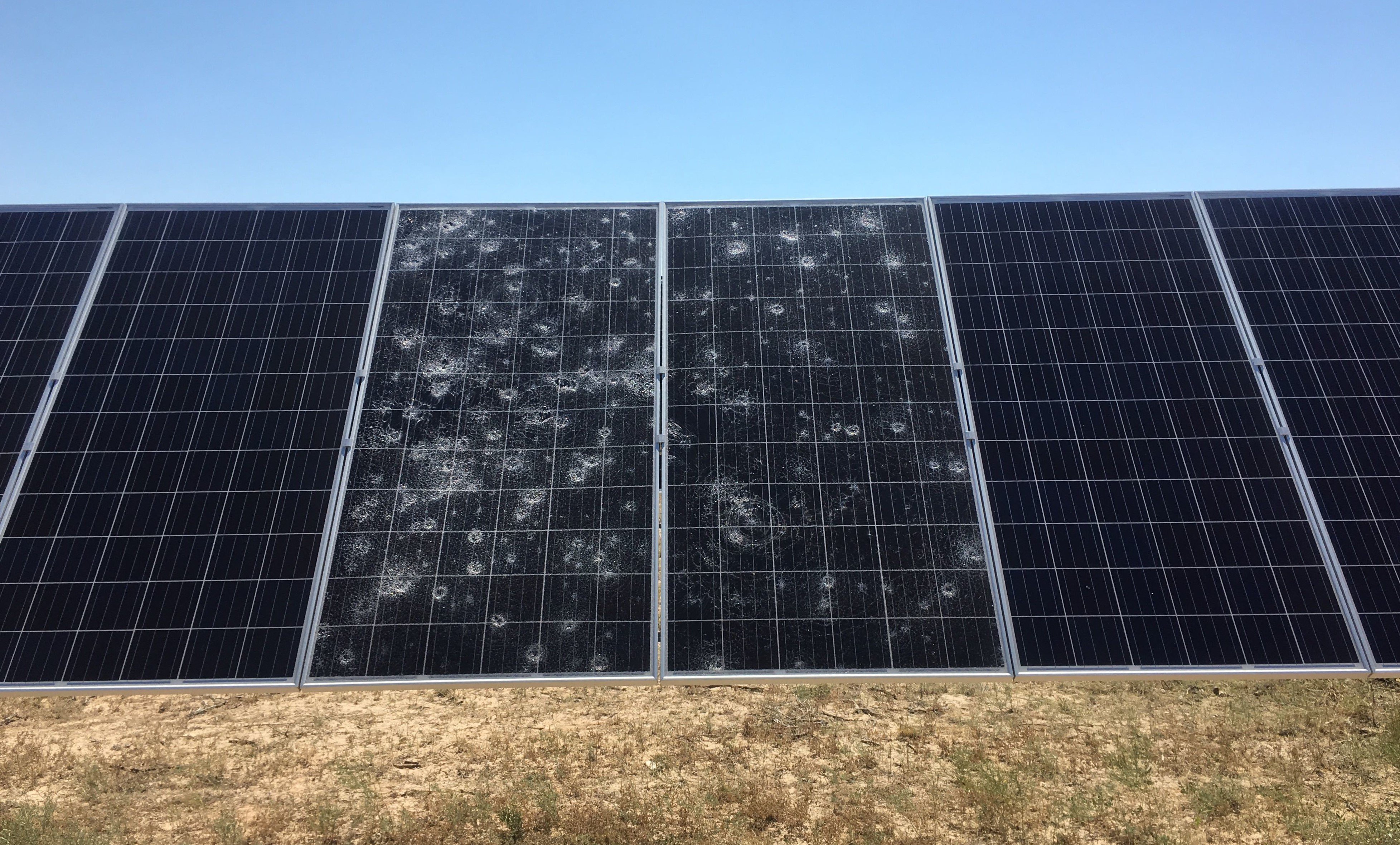 |
| Modules with hail damage. Those without broken glass may have extreme cell cracking, but it is no longer likely that insurance will pay for their replacement. |
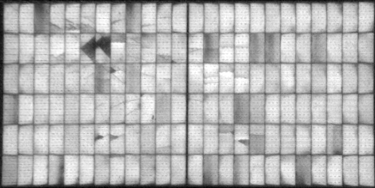 |
| A module with over 25 cracked cells due to hail, which was not eligible for insurance coverage due to changes in insurance policies. |
Materials assessed
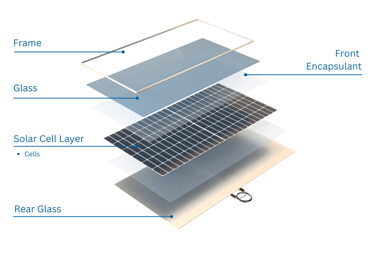
These materials determine how well or poorly a module can withstand hail impacts:
Test procedure
|
As the global climate changes and PV deployment increases to a variety of locations around the world, PV modules mounted in the field may be exposed to severe hail impacts beyond what is covered by the IEC 61215-2:2021 baseline hail test. These hail impacts can result in broken glass. Kiwa PVEL’s Hail-TTF test is focused on determining a module’s susceptibility to hail caused module breakage. While Hail-TTF hail testing follows some of the guidance of IEC 61215-2:2021 MQT 17, each round of hail testing will use six shots per module per hail size at a 0° angle, aimed at the locations most prone to breakage (i.e. module corners, edges and above the junction box holes). The hail size used is specific to the module design: For modules with non-fully tempered glass (such as 2.0 mm glass//glass modules): For modules with fully tempered glass (such as 3.2 mm glass//backsheet, 2.5 mm glass//2.5 mm glass or 3.2 mm glass//2.0 mm glass hail-hardened modules): The pre-stress, interim and final Hail-TTF characterizations include VI only. No light soaking/CID or other characterizations will occur on the Hail-TTF samples. Hail-TTF test results will be presented in a separate Hail-TTF Report, with all characterization results, including module breakage data and images. |
 |