

Potential-Induced Degradation
Why potential-induced degradation testing matters
PID can reduce solar site profits, even when it is reversible. Kiwa Moroni discovered this when they observed a severe case of reversible PID when conducting technical due diligence on a 1 MW plant in Sicily, Italy in 2019. By 2019, the solar plant was underperforming by 9.3%, having suffered a 6.3% loss in expected revenues since the project began operating in 2016.
Kiwa Moroni identified PID as the primary driver of project underperformance through desktop analysis of historic energy production data, in-field EL imaging, IR imaging and IV curve tracing. The firm recommended that the asset owner install an anti-PID device with the expectation that 95% of degradation would be reversed within one year. Despite this recovery the project is expected to be less profitable than modeled by a total of nearly 300,000 Euros over the period from 2016 to 2025.
PID generally happens when there is a negative voltage between a PV module’s frame and cells that causes sodium ions in the module’s glass to migrate into the cells, which are typically coated with a silicon nitride (SiN) anti-reflective coating. In PID-susceptible cells, pinholes in the SiN coating are large enough to allow sodium ions to enter the cell, creating “shunts.” This can cause module performance to be irreparably decreased. Alternatively, a possibly reversible form of PID can occur when the voltage of the PV module’s internal circuit relative to ground creates a buildup of static charge, also causing power loss.
While often thought as limited to transformerless inverter-based sites, PID can on central inverter-based sites while the strings stay at Voc before grid connection or during periods of outages. Asset owners can prevent PID in projects under development by following Kiwa Solar’s best practices. While the first step is to procure BOMs that are not susceptible to PID, ongoing testing and inspection throughout the project lifecycle are vital for quickly remediating PID when it occurs.
 |
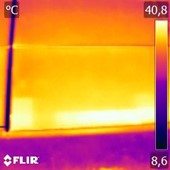 |
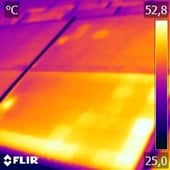
These IR images show elevated temperatures at the edges of the modules by the frame. This indicates PID, which typically has the highest impact around the perimeter of the PV module.
Materials assessed
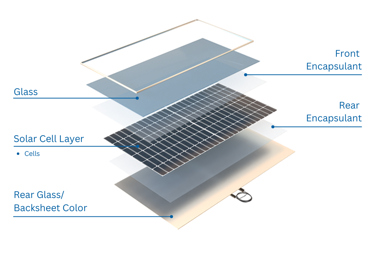
Leakage current can flow from the cells through the encapsulant and glass to the module frame which can result in static charge buildup and/or sodium ions penetrating the cell surface, reducing energy generation. These materials can therefore impact the module’s PID susceptibility:
Test procedure
|
Some electrical codes (including in the USA) dictate that the PV module frame must be electrically grounded, resulting in a potential difference (voltage) between the grounded frames and cells. This voltage drives charge and mobile ions either toward the cell or away from the cell, which can in turn damage the cell pn junction or can cause polarization, both leading to significant impacts to cell efficiency. Following the guidance of IEC 61215:2021 MQT 21, the module is first brought to 85°C, then relative humidity (RH) is ramped to 85%. Once 85°C and 85% RH is achieved, a voltage bias equal to the specified maximum system voltage (MSV) rating is applied between Kiwa PVEL-supplied grounding hardware attached to the module’s frame and the module’s inner circuity for a single run of 192 hours. Both bias polarities are tested, including a negative bias between the inner circuitry and the module’s frame (ground), and a positive bias between the inner circuitry and the module’s frame (ground). Two modules are tested for each allowable polarity. The pre-stress and post-PID characterizations include IV, LIC, EL, LCEL, WL and VI. Some modules experience PID-polarization degradation during dark climate chamber PID testing, which can overlap with PID-shunting degradation and may be recoverable in the field under certain irradiance conditions. Therefore, to quantify the level of PID-polarization degradation recoverability and distinguish impacts of shunting and polarization degradation modes, Kiwa PVEL will automatically perform a ≥0.2 kWh/m2 UV recovery exposure for any BOM that has a post-PID192(-) or post-PID192(+) average power degradation of ≥2% following the guidance of IEC TS 62804-1:2025. Modules will be kept at near-maximum-power-point (Mpp) condition during this UV exposure and IV tested within 48 hours following UV exposure. The post recovery characterizations also include EL, LIC and LCEL. |
 |