
UV-Induced Degradation

New cell technologies such as HJT and TOPCon are marketed with improved first year and annual degradation rates, but both technologies have been shown to be sensitive to ultraviolet light-induced degradation (UVID), in particular when combined with UV-transmitting encapsulants. Kiwa PVEL has developed a new UVID test sequence to assess these concerns as these technologies continue their rapid adoption, although PVEL’s recent testing has shown that commercially mass-deployed PERC modules can also exhibit UVID-related power loss. 

Why UVID testing matters

Historically, UV degradation of PV modules was primarily associated with yellowing of encapsulant and backsheet polymers. More recently, the UV induced degradation vulnerability of high-efficiency modules has been top of mind in the industry due to the increased cell sensitivity to high-energy UV radiation. Research has shown that one the main mechanisms of UVID degradation is damages to the cell passivation layers and interfaces with the silicon bulk caused by UV light.

The equivalent 120 kWh/m2 of front-side UV exposure, with test samples in short-circuit condition (Isc) and a temperature of 60°C, will allow modules buyers to understand if modules are susceptible to UVID in a relatively quick and economical test.  This test duration is equivalent to approximately one or two years of field exposure, depending on the location, and is intended to provide a screening method for assessing the suitability of the manufacturer’s warranty conditions. The test is not designed to measure the full amount of UV-related degradation of PV modules, which would require a much longer UV exposure.

While several researchers have observed a higher degradation when performing rear-side UV exposure, it is important to note that even optimized bifacial systems see an average of less than 10% bifacial gain. Of this rear side irradiance boost, only a limited amount falls within the UV spectral region, so one would expect the annual UV dose on the rear side to be lower than the front side by a factor greater than 10. Thus, Kiwa PVEL’s UVID test has been focused on the most impactful metric which is front side power degradation.
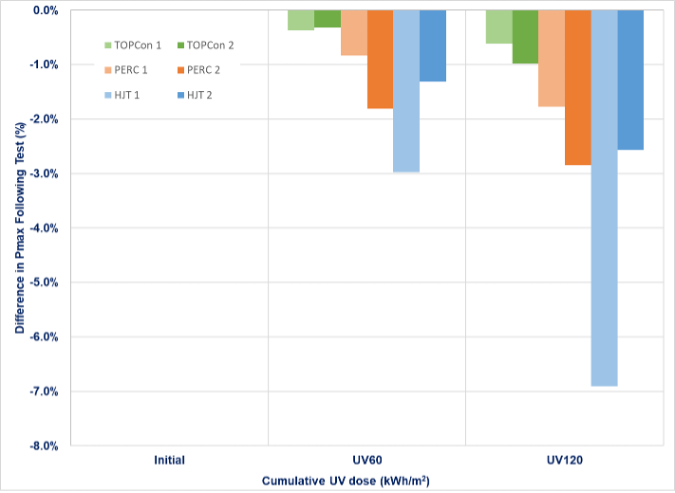
UVID results from PVEL’s recent testing of randomly selected modules shows a range of susceptibilities and power loss. Note: results are not a statistically significant sample of each cell technology and other results may vary.
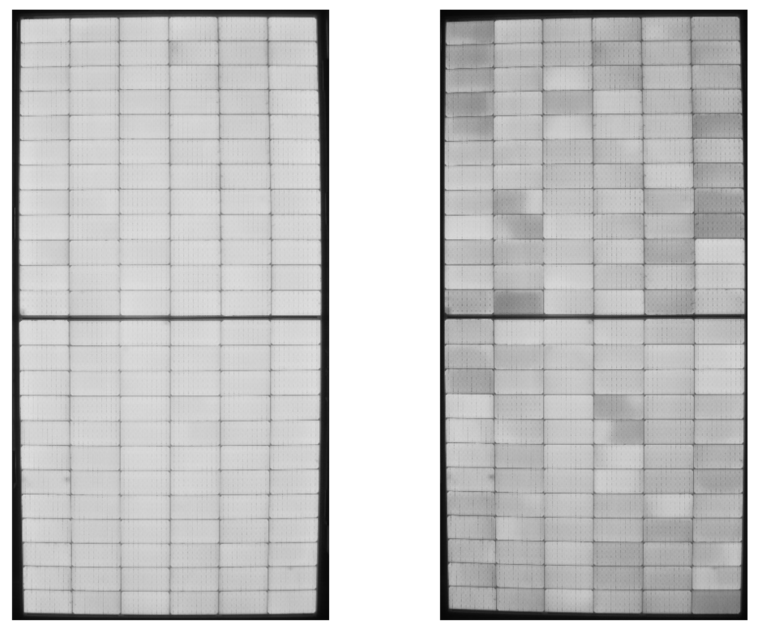
Post-UVID120 change in EL image for a UV-sensitive PERC module.

Materials assessed

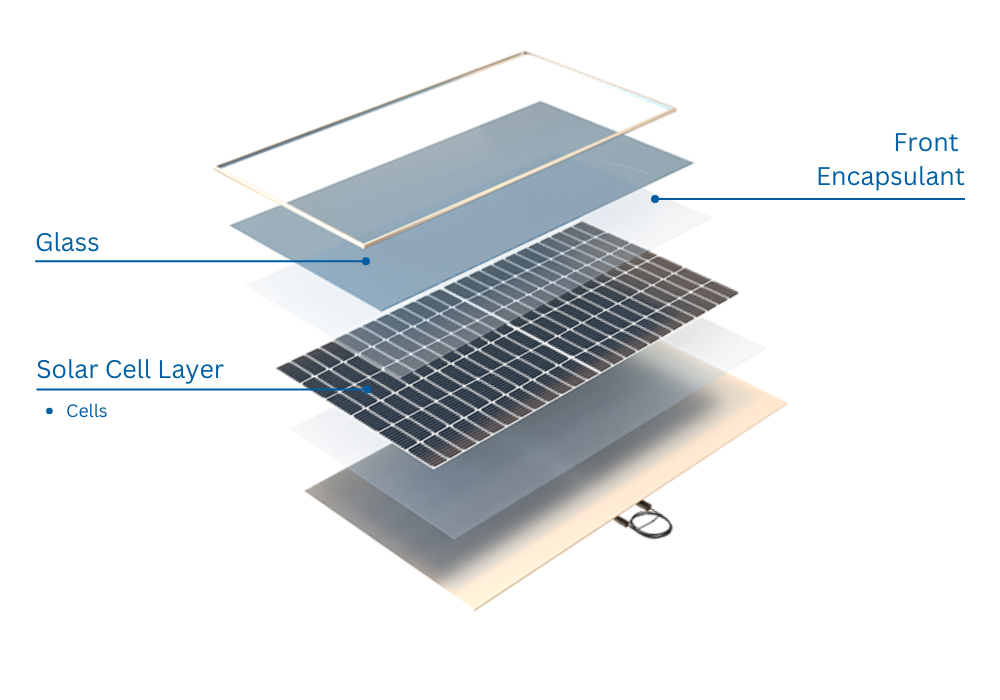
While Kiwa PVEL’s UVID test probes cell-level degradation mechanisms, the layers in front of the cells can impact the level of UV passing to the cells. Therefore these materials influence a PV module’s UVID susceptibility:
 

Test procedure

Current PV modules of various cell technologies are typically advertised to have minimal first year and annual degradation rates, but some have been shown to be sensitive to UVID both in the laboratory and the field. Kiwa PVEL’s UVID test is designed to identify modules that are susceptible to this degradation mechanism in a relatively quick test.

Following the guidance of IEC 61215:2021 MQT 10, the module is subjected to a front-side UV exposure (280-400 nm) of cumulative dose of 120 kWh/m2 (when using metal-halide lamps, or 75 kWh/m2 when using UV fluorescent lamps). The module is placed in short-circuit condition at a temperature of 60°C, while exposed to metal-halide lamps or UV fluorescent lamps that are required to have between 4-7% UVB (280-320 nm) to UV (280-400 nm) ratio. This UV dose creates the same damage as approximately one to two years of field exposure. The test dosage is not necessarily sufficient to identify the maximum amount of power loss resulting from UVID, but the duration is sufficient for UVID-susceptible modules to show higher degradation rates than UV-stable modules.

The pre-stress and post-UVID120 characterizations include IV, LIC, EL, LCEL, WL and VI.

Some modules experience rapid dark storage degradation which could impact the post-UVID results. Therefore, Kiwa PVEL will automatically perform a ≥1 kWh/m2 full spectrum light soak for any BOM that has a post-UVID120 average power degradation of ≥2%. Modules will be kept at open-circuit during this light soaking and IV tested within four hours following light soaking. The post stabilization characterizations also include EL, LIC and LCEL.

3.1.1.      Optional Extended UVID Testing

Following UVID120 testing, the Customer can opt-in to increase the test dose to UVID360. This is particularly encouraged for modules with a significant amount of post- UVID120 power degradation. This optional extended UVID testing includes two more rounds of UV exposure of 120 kWh/m2 (when using metal-halide lamps or 75kWh/m2 when using UV fluorescent lamps) the post-UVID120 samples, following the test conditions described above.

The interim (post-UVID240) characterizations include IV, EL, WL and VI, while the final (post-UVID360) characterizations will also include LIC and LCEL. Following UVID360, the samples will be subjected to a ≥1 kWh/m2 full spectrum light soak, as described above.

This optional extended UVID testing is not included in this Proposal and will be documented on a subsequent change order should the Customer decided to proceed.